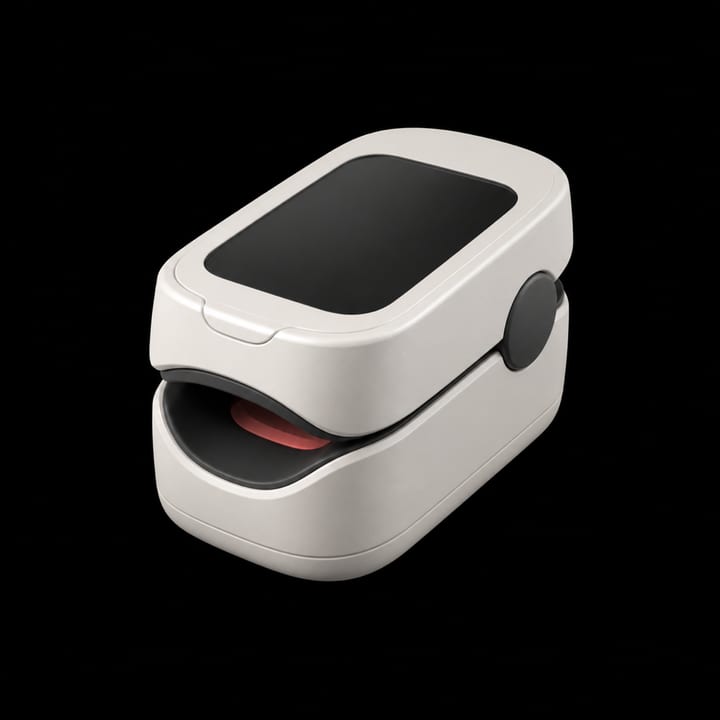
What does your blood oxygen number mean?
On this page
It’s the share of the oxygen seats in your red blood cells that are filled right now. Healthy blood sits near full, so 95 and 99 are the same healthy blood, and a higher number isn’t a better one.
A 96 looks like it lost four points somewhere, but four empty seats in every hundred is how blood looks in almost everyone breathing normal air.
What we’d do
Treat 95 to 100 awake as one zone and stop trying to push the number up. Use it for one job, which is spotting a drop against your own usual numbers on the same device. When it does drop, how you feel decides what happens next.
If you remember three things
- It’s a share of seats taken. 97 means 97 of every 100 oxygen seats on your hemoglobin are filled.
- The top of the range is flat. Healthy people at sea level run 96 to 98 in a blood test, so there’s almost nothing left to fill.
- A full share can still be a small amount. With too little hemoglobin (anemia), every seat can be filled and the blood still carries less oxygen.
Why does a 96 feel like a B grade?
Because it’s a percentage, and everything else in life that’s a percentage wants to be 100. A test score, a phone battery, a charity target. The number on your watch looks like one more of those, so 96 looks four points short.
This one measures how full the seats are on the oxygen carriers in your blood. It says nothing about how fit your lungs are or how much blood you have. Healthy blood leaves a few seats empty, and filling the last few would add very little oxygen.
A simple way to picture it
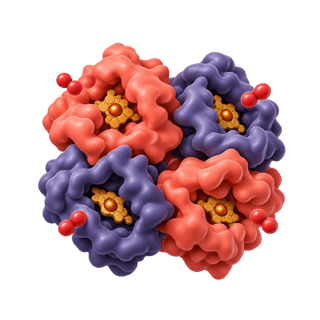
Think of your blood as a long train of buses running past your fingertip. Each bus is a hemoglobin molecule with four seats, and each seat holds one oxygen molecule. Your blood oxygen is the share of seats taken across all the buses going by.
At 97, three seats in every hundred are empty. At 90, ten are. The number says nothing about how many buses there are, which is a separate question your doctor answers with a blood count.
How does oxygen get on and off the seats?
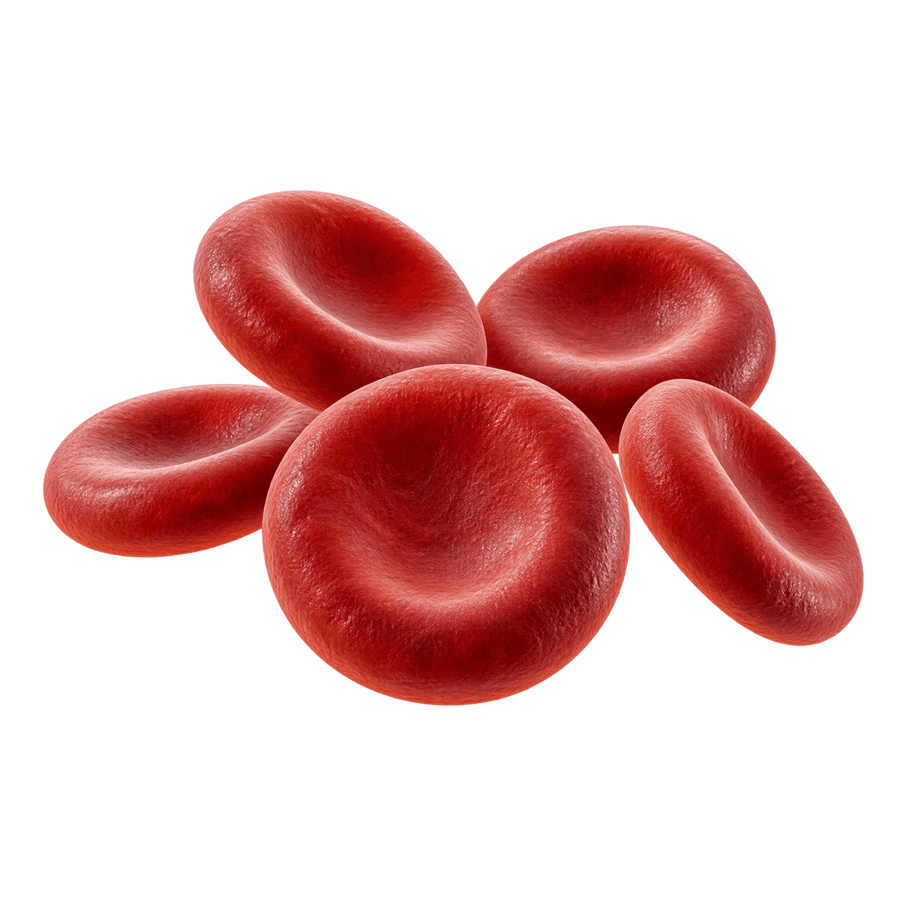
Almost all the oxygen in your blood rides on hemoglobin. Only a very small share dissolves in the liquid part of the blood. In your lungs, hemoglobin passes air that’s full of oxygen and the seats fill. In your muscles and brain, where oxygen is being used up, the seats empty and the oxygen moves into the tissue.
The seats work as a team. When one oxygen molecule sits down, it gets easier for the next one to sit down too, until all four are taken. The same thing works in reverse. That teamwork gives hemoglobin its S-shaped curve. It stays nearly full across a wide range of oxygen in the lungs, then empties fast once the oxygen falls past a certain point.
The flat top is why your number barely changes from day to day at sea level. Healthy people breathing room air at sea level have 96 to 98% of their seats filled in an arterial blood test. Once the seats are nearly all taken, adding more oxygen to the lungs can’t raise the share any further. Only the tiny dissolved part goes up.
The steep side is why altitude, lung trouble and some sleep problems drag the number down so fast once they start. Up high, doctors who study altitude say saturation “changes rapidly in response to small changes in oxygen tensions”.
What do SpO2, SaO2 and PaO2 mean?
They’re three ways of describing the same blood.
| Letters | What it is | How it’s measured | Typical healthy value |
|---|---|---|---|
| SpO2 | Blood oxygen measured by light, the p is for pulse | A finger oximeter, watch or ring | 95 to 100 awake |
| SaO2 | The same share, measured in the blood itself | A sample from an artery, run through a lab machine | 96 to 98 at sea level |
| PaO2 | How hard oxygen is pushing to get into the blood, in mmHg | The same artery sample | Over 60 to 65 is good, says the American Lung Association |
SpO2 is an estimate of SaO2. In critically ill hospital patients with true oxygen of 90 or more, finger oximeters were off by under 2 points on average, and the error grew when true oxygen fell under 90. In 9 young adults breathing low-oxygen air in a lab, a medical finger oximeter and an Apple Watch Series 7 both tended to show higher than the blood test, more so as oxygen fell.
Is 100 better than 96?
No. From 95 up you’re on the flat top of the curve, and the extra points are seats that were going to be filled anyway. In 33,080 Apple Watch wearers the average day was 96.2 and the average night 95.4. The myth page has the long version.
What does a low number tell you, and what doesn’t it?
A low number means fewer seats are filled. The usual reasons are ordinary ones. You were asleep, you’re up high, or the sensor got a bad look at your blood through cold fingers or a loose band. Lung problems such as COPD or pneumonia can lower it too, and MedlinePlus notes that somewhat lower numbers can be acceptable for some people with lung disease.
Awake and resting, MedlinePlus puts normal at 95 to 100, says to contact your doctor at 92 or lower, and to get medical care right away at 88 or lower. If your skin is darker, a finger oximeter in that range can show higher than your true oxygen. In hospital patients whose oximeter showed 92 to 96, true oxygen was under 88 for 11.7% of Black patients’ measurements and 3.6% of White patients’.
What can a normal number hide?
A full share of seats can still mean too little oxygen in two cases.
- Too few buses. In anemia there’s less hemoglobin, so the blood carries less oxygen with little or no change in the share. Halving hemoglobin roughly halves the oxygen your blood carries.
- The wrong passenger. Carbon monoxide takes the same seats as oxygen. A standard two-light oximeter counts those seats as oxygen, so it can show a normal number in carbon monoxide poisoning.
That’s why the warning signs on when to get help come before any number. They don’t depend on what the sensor saw.
More detail: what each number means in seats
| Number | Seats filled, out of 100 | Awake and resting |
|---|---|---|
| 99 | 99 | Normal |
| 96 | 96 | Normal |
| 94 | 94 | A little under, recheck |
| 92 | 92 | Call your doctor |
| 88 | 88 | Get medical care now |
Children’s numbers differ, so ask your child’s doctor.
8 sources
- Collins JA and others, Relating oxygen partial pressure, saturation and content: the haemoglobin-oxygen dissociation curve, Breathe, 2015pmc.ncbi.nlm.nih.gov
- MedlinePlus, Pulse Oximetry, US National Library of Medicine, updated September 12, 2024medlineplus.gov
- American Lung Association, Pulse Oximetrylung.org
- Shapiro I and others, Pulse oximetry values from 33,080 participants in the Apple Heart and Movement Study, npj Digital Medicine, 2023pmc.ncbi.nlm.nih.gov
- Jubran A, Pulse oximetry, Critical Care, 2015pmc.ncbi.nlm.nih.gov
- Jiang Y and others, Performance of wearable pulse oximetry during controlled hypoxia induction: instrument validation study, JMIR Formative Research, 2026pmc.ncbi.nlm.nih.gov
- Sjoding MW and others, Racial bias in pulse oximetry measurement, New England Journal of Medicine, 2020pmc.ncbi.nlm.nih.gov
- Luks AM and Swenson ER, Pulse oximetry at high altitude, High Altitude Medicine and Biology, 2011europepmc.org