What's a normal blood oxygen when you're awake?
On this page
95 to 100 is normal when you’re awake and resting. At 92 or lower, call your doctor. At 88 or lower, get medical care now. And how you feel always outranks the number, in both directions.
Call 911 if you have trouble breathing, chest pain or pressure that doesn't go away, new confusion, can't stay awake, or your lips, nail beds or skin look pale, gray or blue, whatever the number says.
What we’d do
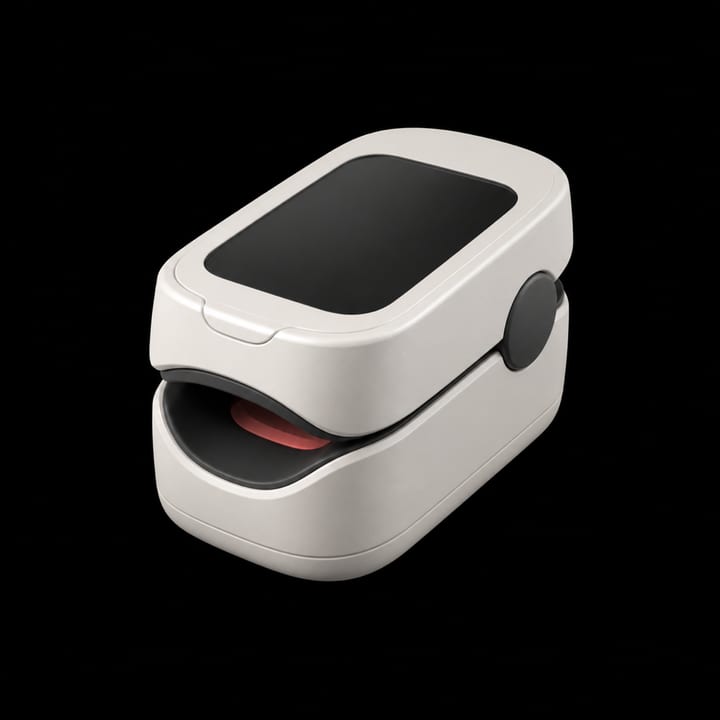
Take the number the same way every time, sitting down after a few minutes still, with warm hands, no dark polish on that finger, and only once the number has settled. If it shows 93 or 94, do it again with the steps below before you think about it. If it stays at 92 or lower, call your doctor today. At 88 or lower, get care now. If you feel short of breath, confused or have chest pain, skip the oximeter and call 911.
If you remember three things
- The lines are 95, 92 and 88. 95 to 100 is normal, 92 or lower means call your doctor, 88 or lower means get care now (MedlinePlus).
- Recheck before you worry. Cold fingers, dark polish and moving can all push the number down.
- Symptoms beat the number. Trouble breathing, chest pain, new confusion or gray or blue lips means 911 even at 97.
Why does my oximeter say 94 when normal starts at 95?
Because the number moves a little, and 95 is only where the normal range starts. A finger oximeter that meets the FDA’s accuracy limit is allowed an average error of about 3 points. A 94 on a cold hand at the end of a walk and a 97 five minutes later on the sofa can be the same blood.
People also hold this number to a stricter standard than any other they measure at home. Nobody calls a doctor over one bathroom scale weighing two pounds heavy. A 94 gets more fear than it deserves because there’s a percent sign on it.
Action starts lower, at 92 and 88, and those lines are for a resting number taken with the steps below. In between, at 93 or 94, the right move is a careful recheck.
A simple way to picture it
Think of the smoke alarm in your kitchen. It can go off when nothing’s on fire, because you burned the toast. And it can stay quiet while something’s wrong, because its battery is low or it’s in the wrong room. Nobody stands in a smoky hallway trusting a silent alarm.
An oximeter works the same way. Cold fingers and nail polish set off false alarms. Darker skin and carbon monoxide can keep it quiet when your oxygen is low. That’s why the warning signs come first and the number second.
How do you check it right?
- Sit down and rest for a few minutes first. A number right after the stairs tells you about the stairs.
- Warm your hands. Cold skin has less blood flowing through it, and the sensor needs the pulse.
- Use a finger without dark polish or an artificial nail. Both block the light. In tests, black, purple and dark blue polish caused the biggest errors.
- Hold still, with your hand resting on something. Movement is one of the biggest causes of wrong numbers.
- Wait for the number to settle. If your oximeter shows a pulse wave or bar, wait until it’s even. A steady wave is how doctors tell a real number from noise.
- Use the same finger and device next time. Then two numbers can be compared.
With a watch, wear it snug on your wrist, rest your arm on a table and stay still. Apple says a loose fit, motion and low blood flow in cold wrists all get in the way. Apple also says its measurements are not intended for medical use, so for an awake check that you’ll act on, a finger oximeter is the better tool.
What do the lines mean?
| Awake and resting | What it means | What to do |
|---|---|---|
| 95 to 100 | Normal | Nothing. Go by how you feel |
| 93 or 94 | A little under | Recheck with warm hands, sitting still, no polish on that finger |
| 89 to 92 | Low | Call your doctor today |
| 88 or lower | Very low | Get medical care now |
The 92 and 88 lines come from MedlinePlus, the US National Library of Medicine’s health site, for people checking at home. The Apple Heart and Movement Study’s authors say much the same, that a number under 92 on room air at sea level generally prompts a closer look.
If your skin is darker, use the 88 to 95 rows with extra care. In hospital patients whose finger oximeter showed 92 to 96, true oxygen was under 88 for 11.7% of Black patients’ measurements and 3.6% of White patients’. A 93 that comes with feeling unwell is a reason to call your doctor whatever the oximeter says.
Does age or elevation change the awake number?
Age barely does. In the Apple Watch study, 20 years of age lowered the typical daytime number by about 0.6 points. A typical day for a 40-year-old at sea level runs about 94.4 to 98.9 on that watch, and for an 80-year-old about 93.2 to 97.6.
Elevation does, because each breath carries less oxygen. MedlinePlus notes numbers can be lower where you live higher up. In Denver, at 5,280 feet, a typical day for a 40-year-old on the watch runs about 93.1 to 97.5. People who live up there often sit a point or two lower, and a new number at or under 92 is still a call. Above about 8,200 feet the bands stop, and how you feel decides. The CDC says people with altitude sickness usually show a number that’s normal for the altitude. Your number, explained takes your age and elevation.
When is the number lower and still fine?
MedlinePlus says somewhat lower numbers can be acceptable for people with lung disease such as COPD. If you have a lung or heart condition, your own doctor sets your range, and their number beats any chart.
The American Lung Association adds that oximeter numbers shouldn’t be used on their own to judge your health, and that abnormal or inconsistent numbers are for your doctor.
A surprising fact about your daytime number
Your blood oxygen has a daily rhythm. Across 72 million measurements from 33,080 Apple Watch wearers, it was highest at about 11 am and lowest at about 1 am. The average day was 96.2. A night number on your watch catches it near its lowest point of the day.
The sceptic says
My oximeter says 91 and I feel completely fine. If I’m not short of breath, why call anyone?
I feel awful but it says 97. The number’s normal, so I can wait it out.
The reply
Recheck, then call. Cold fingers, polish and moving can all cause a low number, so a careful recheck often fixes it. But MedlinePlus’s line for a home oximeter is to contact your doctor at 92 or lower, with no exception for feeling fine.
Your body wins. The CDC’s emergency signs don’t come with a number attached. In 9 young adults breathing low-oxygen air, an Apple Watch Series 7 showed too high 85% of the time once true oxygen was under 88.
Children’s numbers differ, so ask your child’s doctor.
10 sources
- MedlinePlus, Pulse Oximetry, US National Library of Medicine, updated September 12, 2024medlineplus.gov
- CDC, Symptoms of COVID-19, emergency warning signscdc.gov
- Shapiro I and others, Pulse oximetry values from 33,080 participants in the Apple Heart and Movement Study, npj Digital Medicine, 2023pmc.ncbi.nlm.nih.gov
- Collins JA and others, Relating oxygen partial pressure, saturation and content: the haemoglobin-oxygen dissociation curve, Breathe, 2015pmc.ncbi.nlm.nih.gov
- Jubran A, Pulse oximetry, Critical Care, 2015pmc.ncbi.nlm.nih.gov
- Sjoding MW and others, Racial bias in pulse oximetry measurement, New England Journal of Medicine, 2020pmc.ncbi.nlm.nih.gov
- Jiang Y and others, Performance of wearable pulse oximetry during controlled hypoxia induction: instrument validation study, JMIR Formative Research, 2026pmc.ncbi.nlm.nih.gov
- American Lung Association, Pulse Oximetrylung.org
- Apple Support, About Blood Oxygen on Apple Watch, checked 2026-11-14support.apple.com
- CDC Yellow Book, High-Altitude Travel and Altitude Illnesscdc.gov