How does a watch see oxygen through your skin?
On this page
It shines red and infrared light into your skin and watches how the light changes with each heartbeat. Hemoglobin soaks up those two lights differently when it carries oxygen, so the ratio gives the number. A finger clip shines through you, a watch bounces light back, and that costs accuracy.
The method was found by accident in 1972, by an engineer trying to get rid of the very wobble that makes it work.
What we’d do
For a spot check while you’re awake, use a finger oximeter, sitting still with warm hands and no dark polish on that finger. For nights, wear your watch or ring snug, the same way every night. Compare each device only with itself, and expect two devices to disagree by a few points.
If you remember three things
- Only the pulse counts. The sensor ignores the steady light soaked up by skin, bone and veins, and measures the small flicker each heartbeat adds.
- Through a finger beats bouncing off a wrist. A watch catches only the little light that scatters back, and motion, room light and skin differences hit it harder.
- The sensors are least sure when it counts. Oximeters are calibrated on healthy volunteers, and never below about 80%.
Why do my watch and my finger clip disagree?
People expect a number with a percent sign to be exact, like a scale or a thermometer. Blood oxygen from a sensor is an estimate, made from light, through skin, by a formula someone built from volunteers. Each device makes that estimate a little differently, at a different spot on your body and a different moment, so two of them rarely land on the same number.
That’s normal, and it’s why the useful comparison is a device against itself. Our device tool puts any two side by side with the error each one carries.
A simple way to picture it
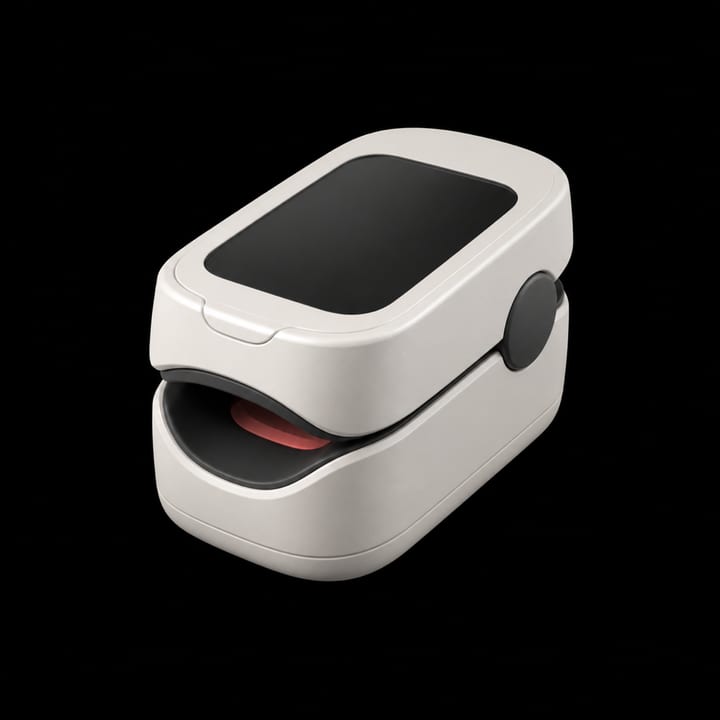
Hold your phone’s flashlight against the back of your finger in a dark room. The light comes through the other side glowing red. That’s how a finger oximeter works, with a light on one side and a detector on the other.
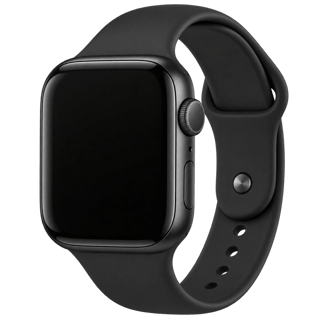
You can’t do that through a wrist, which is too thick. A watch shines its light into the skin and catches the small amount that scatters back out next to it, like trying to judge the color of a drink by shining a light at the glass from the front.
How does the sensor turn light into a number?
- Two colors of light. Most oximeters use red light (660 nm) and infrared light (940 nm), which you can’t see.
- Hemoglobin changes how it soaks them up. Hemoglobin carrying oxygen and hemoglobin without it absorb light differently, and those two wavelengths are picked where the difference is large.
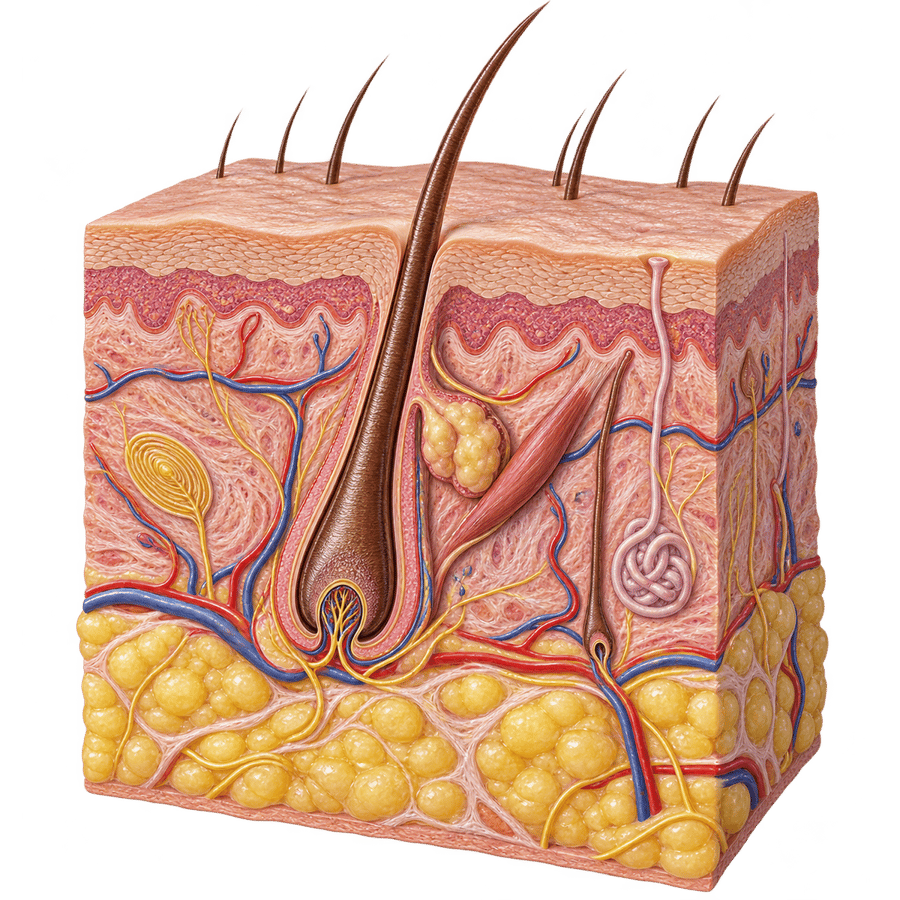
- Most of the light is soaked up steadily. Skin, bone, muscle and the blood in your veins absorb the same amount from moment to moment. Each heartbeat pushes a little extra blood into the arteries, and that adds a small pulse on top.
- The pulse gets compared. The sensor works out how big the pulse is against the steady part, for the red and for the infrared, then divides one by the other. That’s Takuo Aoyagi’s ratio from 1972.
- A table turns the ratio into a percentage. Makers build it by testing healthy volunteers who breathe low-oxygen air while their arterial blood is sampled. For ethical reasons, nobody is taken below about 80% during that testing.
The last step explains why the number gets shaky down low. Below about 80%, the sensor is working past the end of its own calibration. Doctors who study altitude, where numbers that low happen, say device accuracy declines with true saturations under 80%.
Through a finger or off a wrist?
| Finger oximeter | Watch or ring | |
|---|---|---|
| How the light travels | Through the fingertip to a detector on the other side (transmission) | Into the skin and back to a detector on the same side (reflectance) |
| When it measures | While you hold still and look at it | In the background, when you’re still, and when you start one |
| The FDA’s accuracy limit, as one study states it | An average error under 3 points | Under 3.5 points, with a 2025 draft proposing under 3 for both |
| Its weak spots | Cold fingers, dark polish, motion, darker skin | The same, plus a loose fit, room light and less light to work with |
Reflectance sensors suit places like the forehead, chest and wrist, and the researchers who model them say motion, room light and differences in skin hit them harder than finger sensors.
Rings sit on a finger, and we haven’t seen a published test of any ring’s blood oxygen under low oxygen.
When does a watch measure?
Mostly when you aren’t moving. Apple says the Blood Oxygen app measures occasionally in the background when background measurements are on, that how often depends on how active you are, and that it measures during sleep only if Track Sleep with Apple Watch is on. In the Apple Heart and Movement Study, Series 6 watches tried a background measurement about every 30 minutes when the wearer was still.
For an Apple Watch, that means a night’s numbers come from samples taken now and then while you lie still. A finger oximeter shows you a live number for as long as it’s on your finger.
One change since 2025 trips people up. On August 14, 2025, Apple said that for some Series 9, Series 10 and Ultra 2 owners in the US, the sensor data would be measured on the watch and calculated on the paired iPhone, with results in the Health app’s Respiratory section. Apple said a US Customs ruling made it possible. If you have one of those watches, look for your numbers on the phone.
Why do darker skin, cold hands and nail polish throw it off?
- Darker skin. Melanin soaks up more of the shorter, redder light than the longer light. Light that has passed through darker skin is shifted toward the infrared end, the sensor’s ratio comes out smaller, and a smaller ratio turns into a higher number. Most calibration testing is done on volunteers who are about 85% light-skinned. In hospital patients whose finger oximeter showed 92 to 96, true oxygen was under 88 for 11.7% of Black patients’ measurements and 3.6% of White patients’.
- Cold or poorly circulated skin. Less blood flows through cold skin, so the pulse the sensor needs is smaller. Apple says that out in the cold, blood flow in your wrist might be too low for its sensor.
- Nail polish. Dark polish blocks the light. In tests, black, purple and dark blue polish caused the biggest errors, and turning the clip sideways didn’t fix it.
- Motion. Moving makes its own flicker, and the sensor can mistake it for a pulse. It’s a major cause of errors and false alarms in hospitals.
- Carbon monoxide. A two-light sensor can’t tell oxygen from carbon monoxide on hemoglobin, so it can show a normal number in carbon monoxide poisoning.
MedlinePlus lists dark nail polish, artificial nails, darker skin, poor circulation, cold skin and tobacco use as things that can affect the number.
The sceptic says
Hospitals use the same light. If it’s good enough for an ICU, my watch is as good as a medical device.
If it can be 3 points off, why bother? A number that loose can’t tell me anything.
The reply
Same idea, different hardware. In 9 young adults breathing low-oxygen air in a lab, a medical finger oximeter was off by about 3.5 points once true oxygen fell under 88, and an Apple Watch Series 7 by about 6. Apple says its measurements are not intended for medical use.
It’s useful for change. In 50 adults, an Apple Watch Series 6 was off by about 2 points. That’s close enough to notice a clear shift in your own nights on one device, as long as how you feel decides what you do about it.
13 sources
- Severinghaus JW, Takuo Aoyagi: discovery of pulse oximetry, Anesthesia and Analgesia, 2007europepmc.org
- Nitzan M, Romem A and Koppel R, Pulse oximetry: fundamentals and technology update, Medical Devices: Evidence and Research, 2014pmc.ncbi.nlm.nih.gov
- Jubran A, Pulse oximetry, Critical Care, 2015pmc.ncbi.nlm.nih.gov
- Al-Halawani R, Qassem M and Kyriacou PA, Monte Carlo simulation of the effect of melanin concentration on light-tissue interactions in reflectance pulse oximetry, Sensors, 2025pmc.ncbi.nlm.nih.gov
- Benner KJ, Goel NN and Rea MS, Cause, effect, and remediation of melanin-associated bias in pulse oximetry, Journal of Biomedical Optics, 2026pmc.ncbi.nlm.nih.gov
- Jiang Y and others, Performance of wearable pulse oximetry during controlled hypoxia induction: instrument validation study, JMIR Formative Research, 2026pmc.ncbi.nlm.nih.gov
- Sjoding MW and others, Racial bias in pulse oximetry measurement, New England Journal of Medicine, 2020pmc.ncbi.nlm.nih.gov
- Shapiro I and others, Pulse oximetry values from 33,080 participants in the Apple Heart and Movement Study, npj Digital Medicine, 2023pmc.ncbi.nlm.nih.gov
- Apple Support, About Blood Oxygen on Apple Watch, checked 2026-11-14support.apple.com
- Apple Newsroom, An update on Blood Oxygen for Apple Watch in the US, August 14, 2025apple.com
- Luks AM and Swenson ER, Pulse oximetry at high altitude, High Altitude Medicine and Biology, 2011europepmc.org
- MedlinePlus, Pulse Oximetry, US National Library of Medicine, updated September 12, 2024medlineplus.gov
- Collins JA and others, Relating oxygen partial pressure, saturation and content: the haemoglobin-oxygen dissociation curve, Breathe, 2015pmc.ncbi.nlm.nih.gov