
What does SpO2 mean?
On this page
SpO2 is your blood oxygen as a sensor measures it. It’s the share of the oxygen seats in your red blood cells that are filled, worked out from light shone into your skin. Awake and resting, 95 to 100 is normal.
What we’d do
Treat everything from 95 to 100 as the same healthy blood, and stop chasing 100. Compare a lower number with your own usual ones on the same device, and let how you feel outrank it every time.
What do the letters stand for?
The S is saturation, which means how full. O2 is oxygen. The small p tells you the number came from a pulse oximeter, the clip on your finger or the sensor on the back of a watch or ring. Doctors write SaO2, with an a, for the same thing measured in a blood sample from an artery. When researchers want to know how far a sensor was off, they put the two side by side, which is how a 2020 hospital study caught pulse oximeters showing too high in some patients.
What is it measuring?
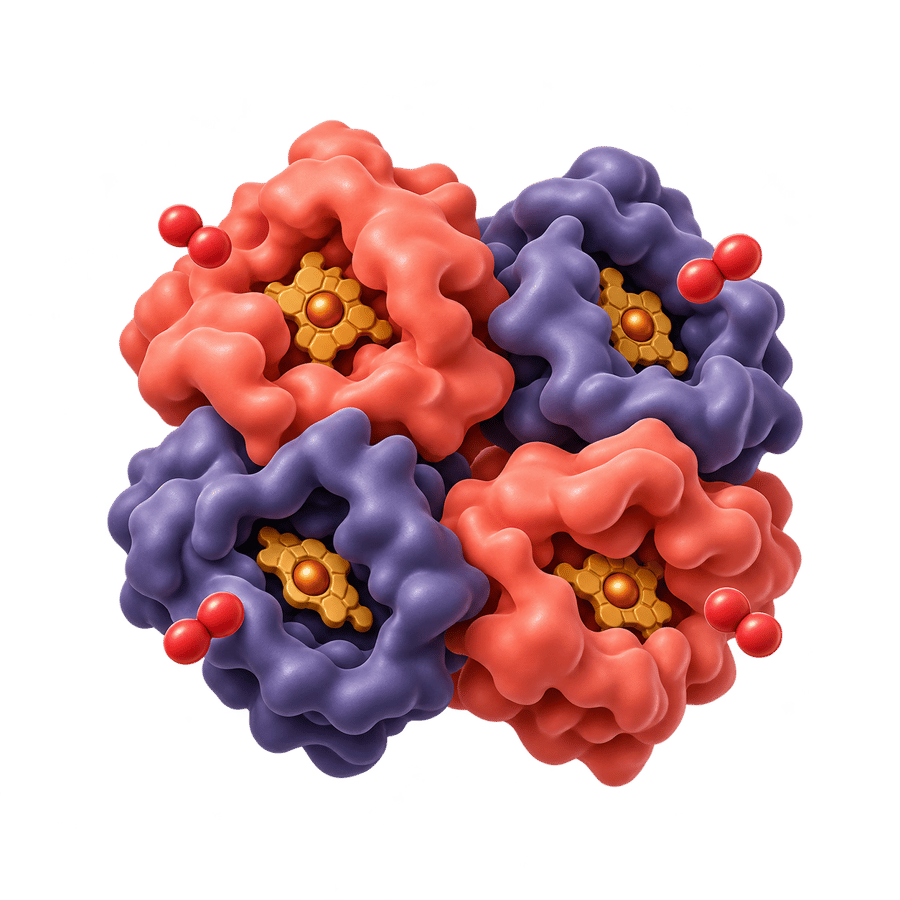
Your red blood cells carry oxygen from your lungs to the rest of you, and each one only has so many seats for it. SpO2 is the share of those seats that are taken. At 97, about 97 of every 100 are full.
Think of a bus line where every bus leaves the depot nearly full. A bus at 96% and one at 99% carry almost the same number of people, so healthy blood at 96 and 99 delivers about the same oxygen. The number tells you how full the buses are. It tells you nothing about how many buses are running.
How does a sensor see it through your skin?
Blood carrying oxygen soaks up red and infrared light differently from blood without it. The sensor shines both into you, measures what comes back out, and only counts the part of the light that changes with each heartbeat.
That trick was found by accident. In 1972 Takuo Aoyagi, an engineer at Nihon Kohden in Tokyo, was using an ear oximeter to measure how much blood the heart pumps, and the pulse kept getting in the way. He tried to cancel it out by balancing the red and infrared signals, and found that changes in oxygen broke his cancelling. The noise was the measurement. Minolta sold an instrument built on his idea around 1978, and by the mid 1980s other companies were selling pulse oximeters around the world.
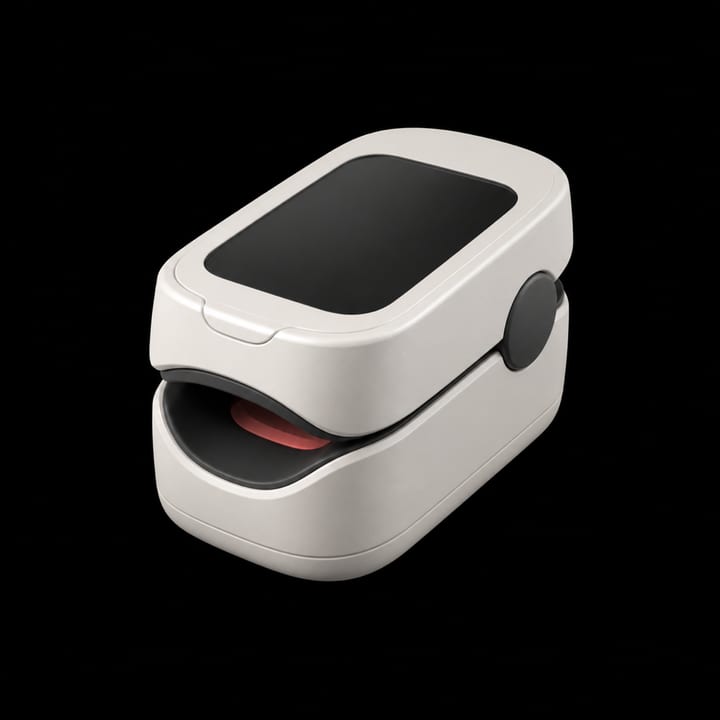
A finger clip shines its light through your fingertip to a detector on the other side. A watch, or a ring like Oura, shines it into your skin and catches what bounces back, which is harder. In 9 young adults breathing controlled low oxygen, an Apple Watch Series 7 missed the blood test by more than a medical finger oximeter did (more in how devices measure).
What’s a normal SpO2?
| When | Normal | Source |
|---|---|---|
| Awake and resting | 95 to 100. Call your doctor at 92 or lower, and get medical care now at 88 or lower | MedlinePlus, US National Library of Medicine, 2024 |
| A watch’s night average | About a point under your daytime number. 33,080 Apple Watch wearers averaged 96.2 by day and 95.4 at night | Shapiro and others, 2023 |
| The lowest point of a night | Averaged about 90 in 350 people with normal sleep studies | Gries and Brooks, 1996 |
| Where you live higher up | Lower than at sea level, by about a point for every 3,300 feet at night | MedlinePlus, Shapiro and others |
The tool below takes any number, the moment it came from and the device that showed it, and tells you where it sits. Every whole number from 85 to 100 also has its own page.
7 sources
- MedlinePlus, Pulse Oximetry, US National Library of Medicine, updated September 12, 2024medlineplus.gov
- Sjoding MW and others, Racial bias in pulse oximetry measurement, New England Journal of Medicine, 2020pmc.ncbi.nlm.nih.gov
- Severinghaus JW, Takuo Aoyagi: discovery of pulse oximetry, Anesthesia and Analgesia, 2007europepmc.org
- Jiang and others, an Apple Watch Series 7 and a medical-grade finger oximeter against arterial blood tests in 9 healthy adults under controlled low oxygen, 2026pmc.ncbi.nlm.nih.gov
- Shapiro I and others, Pulse oximetry values from 33,080 participants in the Apple Heart and Movement Study, npj Digital Medicine, 2023pmc.ncbi.nlm.nih.gov
- Gries RE and Brooks LJ, Normal oxyhemoglobin saturation during sleep: how low does it go?, Chest, 1996europepmc.org
- Oura, Blood oxygen sensing (SpO2), August 27, 2024, checked 2026-11-14ouraring.com