
Is VO2 max the same as blood oxygen?
No. Blood oxygen is how full your red blood cells are with oxygen, and healthy people sit near the top, 95 to 100 awake. VO2 max is how much oxygen your body can use in a minute at full effort, and that’s the one training raises.
What we’d do
Don’t try to train your blood oxygen up. Check it’s in range and leave it alone. If you want an oxygen number to improve, VO2 max is the one, and vo2max.guide covers how to measure and raise yours.
How are they different?
| Blood oxygen (SpO2) | VO2 max | |
|---|---|---|
| What it measures | How full your red blood cells are with oxygen, as a share | The most oxygen your body can use in a minute, flat out |
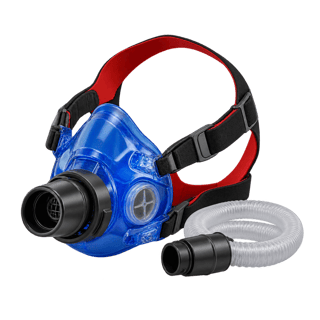
| How you get it | A finger clip or a watch, in seconds, sitting still | A treadmill or bike test with a mask, or a watch’s estimate from your runs and walks |
| What’s normal | 95 to 100 awake, for nearly every healthy adult | Varies a lot from person to person |
| Does training raise it? | There’s little room, since healthy blood is already nearly full | Yes. Hard intervals raised it about 7% in 8 weeks in one trial |
People mix them up for a good reason. Both have oxygen in the name, both show up on the same watch, and both drop when you go to the mountains.
How are they connected?
Oxygen goes from your lungs into your blood, your heart pumps that blood to your muscles, and the muscles use it. Blood oxygen checks the first step, at rest. VO2 max is the whole chain at full effort.
Picture a delivery company. Blood oxygen is how full each truck is when it leaves the depot. VO2 max is how many packages the whole fleet can deliver in an hour. Trucks that leave full are the starting point, and after that the number of trucks on the road decides it.
Exercise scientists David Bassett and Edward Howley laid out the evidence in 2000. In healthy people, getting oxygen to the muscles is what limits VO2 max. When blood doping, thin mountain air or beta blockers change how much oxygen arrives, VO2 max moves with it. And training raises VO2 max mainly by making the heart pump more blood each minute.
A 2007 Norwegian trial showed how fast that happens. In 40 moderately trained men, three sessions a week of four-minute hard intervals raised VO2 max by 7.2% in 8 weeks, and the heart’s output per beat rose by about 10%.
Why do both drop at altitude?
Each breath up high carries less oxygen. At about 10,000 feet it’s 69% of what you’d get at sea level, the CDC says, and a newly arrived visitor’s blood oxygen can drop to 88 to 91 there. Less oxygen in the blood means less reaching the muscles, and thin mountain air is one of Bassett and Howley’s examples of what lowers VO2 max.
4 sources
- MedlinePlus, Pulse Oximetry, US National Library of Medicine, updated September 12, 2024medlineplus.gov
- Bassett DR and Howley ET, Limiting factors for maximum oxygen uptake and determinants of endurance performance, Medicine and Science in Sports and Exercise, 2000europepmc.org
- Helgerud J and others, Aerobic high-intensity intervals improve VO2max more than moderate training, Medicine and Science in Sports and Exercise, 2007europepmc.org
- CDC Yellow Book, High-Altitude Travel and Altitude Illness, updated April 23, 2025cdc.gov