Your watch is as good as a medical oximeter
Short answerNo
On this page
No. Apple says its Blood Oxygen measurements are not intended for medical use. In a lab test that lowered people’s oxygen, an Apple Watch Series 7 was off by about 6 points once true oxygen fell under 88, against about 3.5 for a medical finger oximeter. A watch is good for following your nights, and a finger oximeter is the better tool for a check you’ll act on.
What we’d do
Use the watch or ring for what it’s good at, which is a number every night without thinking about it. Compare those nights with each other. For an awake check you might act on, use a finger oximeter, sitting still with warm hands. If the two disagree, judge each against its own usual numbers, and let how you feel decide.
If you remember three things
- Apple says it plainly. Its Blood Oxygen measurements are “not intended for medical use”.
- Watches drift high when oxygen is low. Below a true 88, the Series 7 showed too high 85% of the time.
- Most watches and rings have no published test. We haven’t seen one for Oura, WHOOP, Fitbit, Pixel Watch or Samsung.
Why it sounds right
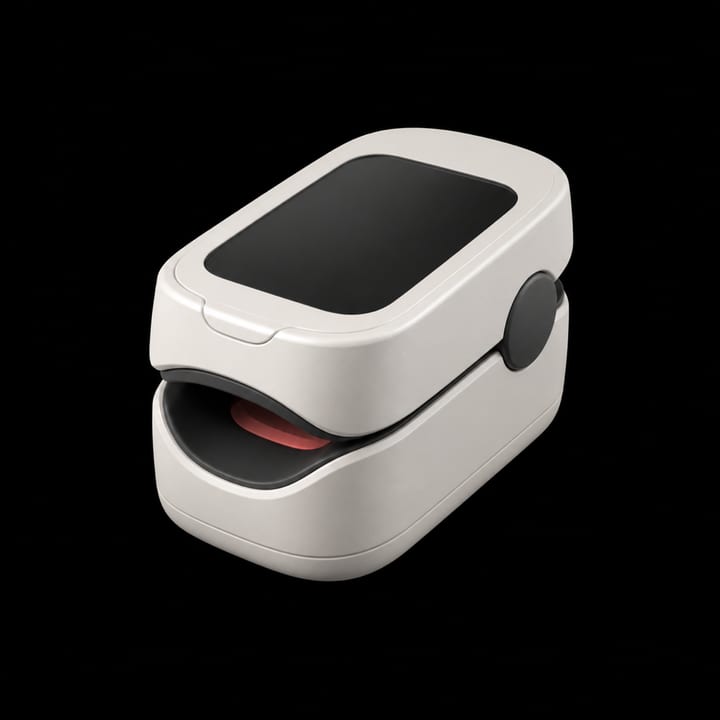
It’s the same idea. Both shine red and infrared light into you and look at the pulse. The watch is newer and cost more, so it’s natural to assume it matches a drugstore finger clip, which the CDC says costs under $30, or beats it.
The light is the same, but a watch has far less of it to work with.
Does a phone camera match a big camera in the dark?
In daylight, a phone camera and a big camera with a large lens take pictures most people can’t tell apart. In a dark room, the phone’s picture falls apart first, because it has less light to work with.
A watch is the phone camera. When your oxygen is normal, it’s close to a finger oximeter. When oxygen drops, the job gets harder and the watch’s numbers drift further from the truth than the finger clip’s.
Why does a wrist lose to a fingertip?
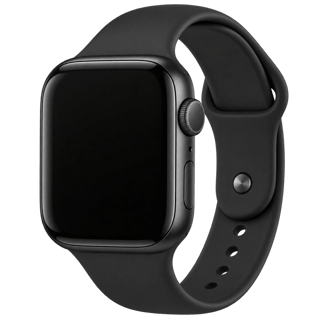
A finger oximeter shines light through your fingertip to a detector on the other side. A watch can’t shine through a wrist, so its light and detector sit on the same surface, and it catches the small amount of light that scatters back out of the skin. Researchers who model these sensors say motion, room light and differences in skin hit that kind of sensor harder.
The two also measure at different moments. A finger oximeter shows a live number while you hold still and watch it. An Apple Watch measures occasionally in the background when you’re still, and in the 33,080-person Apple study, Series 6 watches tried about every 30 minutes.
What did the tests find?
Watch against finger, in the lab
9 healthy adults aged 19 to 28, oxygen lowered under supervision, arterial blood drawn. Jiang, JMIR Formative Research, 2026
Across the test, the medical finger oximeter was off by about 3 points and the Apple Watch Series 7 by about 4.6. Below a true 88, about 3.5 against about 6. 49% of the finger oximeter’s numbers were within 2 points of the blood test, against 32% of the watch’s. Both leaned high.
Nine young people, one watch model.
An older watch in a bigger group
50 healthy adults, Apple Watch Series 6, as cited by Jiang, 2026
Off by about 2 points on average, with a trend toward showing too high.
Reported secondhand.
A Garmin on a mountain
13 healthy lowlanders after a fast climb to 14,957 feet. Schiefer, Sensors, 2021
Blood tests averaged 75%. A medical finger oximeter showed 81% and was off by about 0.1 on average. A Garmin Fenix 5X Plus showed 85%, 7 points high, and the researchers said it “cannot be recommended” up high.
One older Garmin model.
The FDA’s accuracy limits, as the 2026 paper states them, are an average error under 3 points for finger oximeters and under 3.5 for reflectance sensors like a watch’s. Under low oxygen, both devices in that test went past their limit.
Skin tone adds to it for both kinds. In hospital patients whose finger oximeter showed 92 to 96, true oxygen was under 88 for 11.7% of Black patients’ measurements and 3.6% of White patients’. A 2025 modeling study found melanin cuts the red light that reaches a reflectance sensor, the kind in a watch, more than the infrared, with the error growing on darker skin.
The best case for the myth
“In the 50-adult test, the Series 6 was off by only about 2 points. That’s as good as plenty of finger oximeters.” It is, in healthy people at normal levels, and that’s why a watch is useful for tracking your nights. The gap opens as oxygen falls, which is exactly when you’d want to rely on the number. In the lab test, the finger oximeter beat the watch overall, and by more below 88. Which device? puts any two side by side with the error each one carries.
Is my blood oxygen normal? Take the quiz All the myths
8 sources
- Jiang Y and others, Performance of wearable pulse oximetry during controlled hypoxia induction: instrument validation study, JMIR Formative Research, 2026pmc.ncbi.nlm.nih.gov
- Apple Support, About Blood Oxygen on Apple Watch, checked 2026-11-14support.apple.com
- Schiefer LM and others, Validity of peripheral oxygen saturation measurements with the Garmin Fenix 5X Plus wearable device at 4559 m, Sensors, 2021europepmc.org
- Nitzan M, Romem A and Koppel R, Pulse oximetry: fundamentals and technology update, Medical Devices: Evidence and Research, 2014pmc.ncbi.nlm.nih.gov
- Al-Halawani R, Qassem M and Kyriacou PA, Monte Carlo simulation of the effect of melanin concentration on light-tissue interactions in reflectance pulse oximetry, Sensors, 2025pmc.ncbi.nlm.nih.gov
- Shapiro I and others, Pulse oximetry values from 33,080 participants in the Apple Heart and Movement Study, npj Digital Medicine, 2023pmc.ncbi.nlm.nih.gov
- Sjoding MW and others, Racial bias in pulse oximetry measurement, New England Journal of Medicine, 2020pmc.ncbi.nlm.nih.gov
- CDC Yellow Book, High-Altitude Travel and Altitude Illness, on the cost of pulse oximeterscdc.gov