Your oxygen number tells you if you have altitude sickness
Short answerNo
On this page
No. The CDC says people with altitude sickness usually show a number that’s normal for the altitude, or only a little lower. Everyone’s number drops up high, sick or well. A headache with nausea, tiredness or dizziness after a climb is what decides it.
Call 911 if you have trouble breathing, chest pain or pressure that doesn't go away, new confusion, can't stay awake, or your lips, nail beds or skin look pale, gray or blue, whatever the number says.
What we’d do
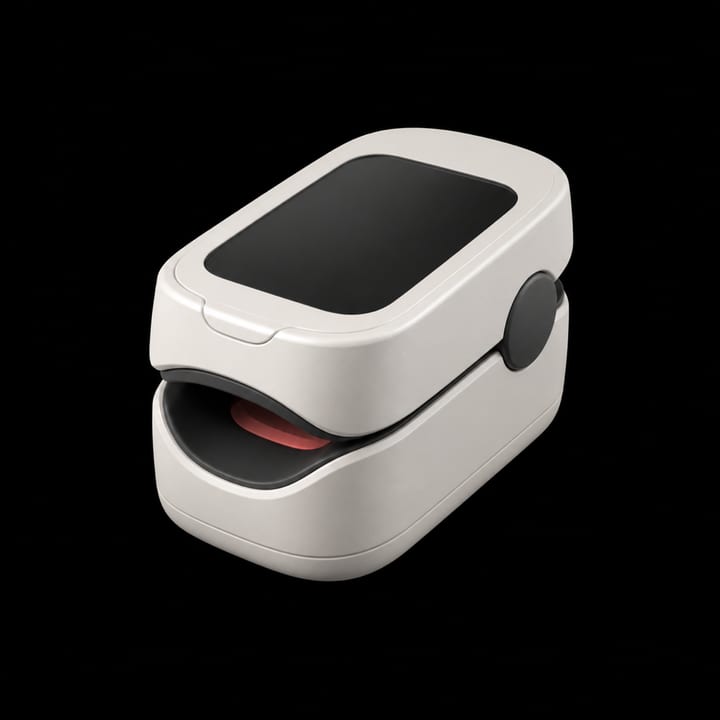
Bring the oximeter if you like it, and use it for curiosity. Make the call on symptoms. Each morning up high, rate headache, stomach, tiredness and dizziness. With symptoms, don’t go higher. If they get worse despite rest, go down, since 1,000 feet or more usually helps quickly. Confusion, clumsiness or real trouble breathing means get help now.
If you remember three things
- Sick and well people show similar numbers. Doctors who study altitude say the normal number at an elevation is a range of values.
- Symptoms decide. Headache plus stomach trouble, tiredness or dizziness, 6 hours or more after arriving.
- Some sensors flatter you up high. A Garmin showed 7 points too high at 14,957 feet.
Why it sounds right
Altitude sickness is caused by thin air, and the oximeter measures what thin air does to your blood. Connecting the two seems obvious.
The number does tell you the air is thin. What it can’t tell you is how your body is handling it.
Can a fuel gauge tell you about a flat tire?
A car’s fuel gauge is a good instrument. It tells you how much is in the tank, and it’s useless for telling you a tire is going flat. You’d find that out from how the car drives.
Up high, your oximeter is the fuel gauge. It shows less oxygen in your blood, which is true of everyone up there. Altitude sickness shows up in how you feel.
Why can’t the number tell sick from well?
- Everyone’s number falls. Each breath at 10,000 feet carries about 69% of the oxygen it does at sea level, the CDC says. Your number drops whether or not you feel fine.
- The normal is a wide range. Doctors who study altitude say the normal number at a given elevation “should be viewed as a range of values, rather than a specific number”, and that decisions shouldn’t rest on small differences between people or from one check to the next.
- The line gets steep. In the Apple Watch study of 33,080 people, the straight line between elevation and blood oxygen held up to about 8,200 feet and bent above it. Up there, a small change in the air moves the number a lot, for everyone.
- The sensors drift. In 13 healthy lowlanders after a fast climb to 14,957 feet, blood tests averaged 75%, a medical oximeter showed 81% and a Garmin 85%. Device accuracy declines once true saturation falls under 80%, and darker skin pushes numbers higher too. In hospital patients whose finger oximeter showed 92 to 96, true oxygen was under 88 for 11.7% of Black patients’ measurements and 3.6% of White patients’.
What does decide it?
The 2018 Lake Louise score, the check altitude doctors use. After a recent climb and at least 6 hours at the new elevation, rate four symptoms from 0 (none) to 3 (severe, hard to function).
| Symptom | What counts |
|---|---|
| Headache | From mild to severe |
| Stomach | Poor appetite or nausea, up to vomiting |
| Tiredness or weakness | From a little to hard to function |
| Dizziness or light-headedness | From mild to severe |
Three points or more, with at least one from the headache, is acute mountain sickness. Symptoms usually start 2 to 12 hours after arrival, the CDC says, and new symptoms after 3 days at the same elevation shouldn’t be put down to it.
It’s common. In 3,158 adult visitors to Colorado resorts from 6,300 to 9,700 feet, a quarter got it, and those living below 3,000 feet were 3.5 times as likely. The trip tool includes the morning check for each day.
Is the number ever useful up high?
Yes, with the right symptoms beside it. Fluid in the lungs at altitude (high-altitude pulmonary edema) starts with chest congestion, a cough, much more breathlessness than usual on effort and falling performance, and there the CDC says oxygen numbers of 50% to 70% are common. The other serious form, high-altitude cerebral edema, brings confusion, clumsiness and drowsiness. Either set of signs means get medical help now, and the number is a detail.
The best case for the myth
“Mountain guides and expedition doctors use oximeters all the time.” Some do, as one input next to how a person looks and feels, and the CDC notes a cheap oximeter can help travelers follow how they’re getting used to altitude. But the CDC’s own rules for when to stop or go down are written around symptoms. Never go higher to sleep with symptoms, and go down if they get worse despite rest.
Is my blood oxygen normal? Take the quiz All the myths
8 sources
- CDC Yellow Book, High-Altitude Travel and Altitude Illnesscdc.gov
- Luks AM and Swenson ER, Pulse oximetry at high altitude, High Altitude Medicine and Biology, 2011europepmc.org
- Roach RC and others, The 2018 Lake Louise Acute Mountain Sickness Score, High Altitude Medicine and Biology, 2018pmc.ncbi.nlm.nih.gov
- Honigman B and others, Acute mountain sickness in a general tourist population at moderate altitudes, Annals of Internal Medicine, 1993europepmc.org
- Schiefer LM and others, Validity of peripheral oxygen saturation measurements with the Garmin Fenix 5X Plus wearable device at 4559 m, Sensors, 2021europepmc.org
- Shapiro I and others, Pulse oximetry values from 33,080 participants in the Apple Heart and Movement Study, npj Digital Medicine, 2023pmc.ncbi.nlm.nih.gov
- Sjoding MW and others, Racial bias in pulse oximetry measurement, New England Journal of Medicine, 2020pmc.ncbi.nlm.nih.gov
- CDC, Symptoms of COVID-19, emergency warning signscdc.gov