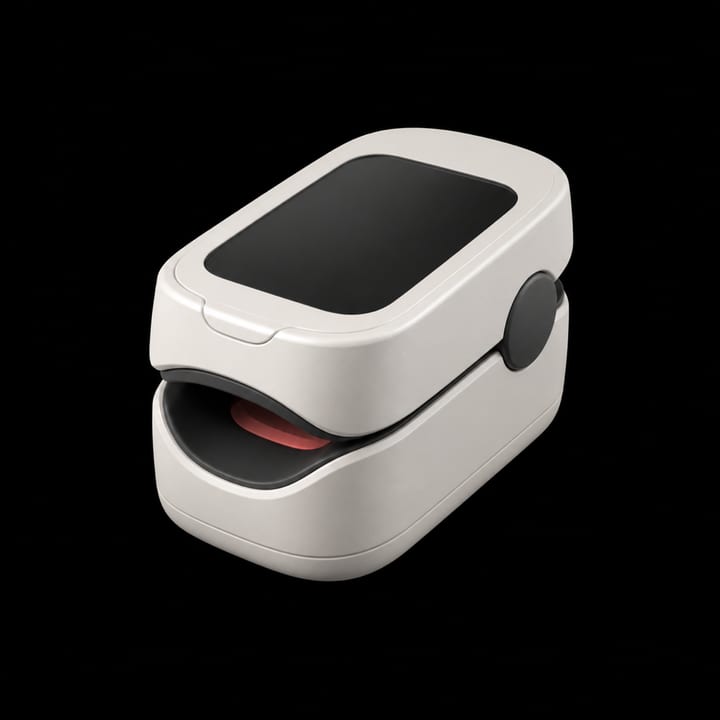
What is normal blood oxygen while sleeping?
On this page
On a watch at sea level, a typical night average for a 40-year-old runs from about 93.5 to 98.4, a little under the daytime number. Inside that night, the lowest dip of a healthy sleeper averaged about 90 in a sleep lab.
What we’d do
Find out which night number you’re looking at before you judge it. Compare a night average with your own usual nights on the same device. Treat one low dip as normal, and ask your doctor about a sleep study if the low points keep coming, or someone has seen you stop breathing, or you snore loudly and you’re sleepy by day.
Which night number are you looking at?
Most of the worry about night oxygen comes from mixing up three different numbers.
| Number | What it is | What’s normal |
|---|---|---|
| The night’s average | All the night’s values averaged. Oura shows this as Average Blood Oxygen | About 93.5 to 98.4 on a watch at sea level, age 40. Under 90 is a reason to talk to your doctor, especially if it repeats |
| The lowest point | The single lowest value of the night | Averaged 90.4 in 350 healthy sleepers, with most between about 84 and 97 |
| One measurement | Any single value. An Apple Watch measures now and then while you’re still, and the Health app lists each one | Apple says slightly lower values in sleep are expected, and some people see values below 95 |
The night average is the one to track from night to night. The lowest point is the one that scares people, and a healthy night’s lowest point sits well below its average.
Why is it lower at night?
You breathe less air in sleep. In a 1985 study, researchers measured six healthy men through the night. Awake they breathed about 6.3 liters of air a minute, in deep sleep 5.7 and in dream (REM) sleep 5.4, and their blood oxygen slipped from 97.3 to 96.5 and 96.2. The drop in breathing explained the whole fall.
It’s like a car idling at a red light. The engine turns slower and nothing’s wrong with it. In the 33,080 Apple Watch wearers, the night ran about 0.8 points under the day, with the lowest values around 1 am and the highest around 11 am.
What’s typical for your age and where you live?
Typical watch night averages for someone with a BMI of 25, the range where about 95 in 100 wearers like you sit if the spread follows the usual bell curve:
| Age | Sea level | Denver, 5,280 feet |
|---|---|---|
| 25 | 94.2 to 99.0 | 92.3 to 97.1 |
| 45 | 93.3 to 98.2 | 91.4 to 96.3 |
| 65 | 92.5 to 97.3 | 90.6 to 95.4 |
These come from one watch model (the Series 6) in US wearers, and they describe a person’s usual nights, so a single night can wobble outside them. Elevation moves a night more than age does: about 1.2 points for every 3,300 feet you live higher.
What makes one night lower than usual?
- Sleeping higher than usual. A ski trip or a mountain town lowers every night you’re there (what’s normal at altitude).
- Drinks. In 14 trials, alcohol lowered the night’s average by about 0.6 points and its lowest point by about 1.25 (alcohol and blood oxygen).
- Your back, if your airway narrows in sleep. In 12,036 sleep-center patients with apnea, two in three were worse on their back (back sleeping).
If one night looks low, the three-night check gives you a dated card to fill in, so you can tell one low night from a pattern.
7 sources
- Shapiro I and others, Pulse oximetry values from 33,080 participants in the Apple Heart and Movement Study, npj Digital Medicine, 2023pmc.ncbi.nlm.nih.gov
- Gries RE and Brooks LJ, Normal oxyhemoglobin saturation during sleep: how low does it go?, Chest, 1996europepmc.org
- Stradling JR, Chadwick GA and Frew AJ, Changes in ventilation and its components in normal subjects during sleep, Thorax, 1985pmc.ncbi.nlm.nih.gov
- Apple Support, About Blood Oxygen on Apple Watch, checked 2026-11-14support.apple.com
- Oura, Blood oxygen sensing (SpO2), August 27, 2024, checked 2026-11-14ouraring.com
- Kolla BP and others, The impact of alcohol on breathing parameters during sleep: a systematic review and meta-analysis, Sleep Medicine Reviews, 2018europepmc.org
- Rosa CFA and others, Analysis of positional obstructive sleep apnea features in 12,000 patients at a sleep center, Sleep and Breathing, 2026europepmc.org