Does sleeping on your back lower your oxygen?
On this page
It can, in people whose airway narrows in sleep. In 12,036 sleep-center patients with apnea, two in three had apnea that was worse on their back, and more than a quarter had it only on their back. Sleeping on your side is a free three-night test.
What we’d do
If your nights look low and you mostly sleep on your back, try three nights on your side with everything else kept the same, and compare them with three ordinary nights. If someone has seen you stop breathing in your sleep, skip the experiment and ask your doctor about a sleep study.
What did the sleep-center study find?
Doctors in a sleep center went back through the overnight studies of 12,036 patients with apnea, tested between 2017 and 2023. In 66.3% of them, the apnea depended on position and was worse lying on their back. In 27.8%, it showed up only on their back.
The people whose apnea depended on position were better off in several ways. They had fewer breathing events, about 24 an hour against 44 in everyone else, a lower average BMI (29.2 against 31.4), and better oxygen through the night once the researchers allowed for how many events they had.
Some airways behave like a garden hose that only kinks when it’s lying a certain way. Turn it over and the water flows again.
What if you don’t have apnea?
We haven’t seen a study showing that back sleeping lowers blood oxygen in people without apnea. The study above was only in people sent to a sleep center. In 350 healthy sleepers, the lowest point of the night averaged about 90, so a dip to 89 or 90 on its own is normal for a back sleeper too.
How do you test it on yourself?
- Pick three nights with no travel and no change in elevation.
- Keep drinks the same as usual, or skip them, since alcohol adds breathing pauses on its own, more in snorers.
- Sleep on your side. A pillow behind your back can stop you rolling over.
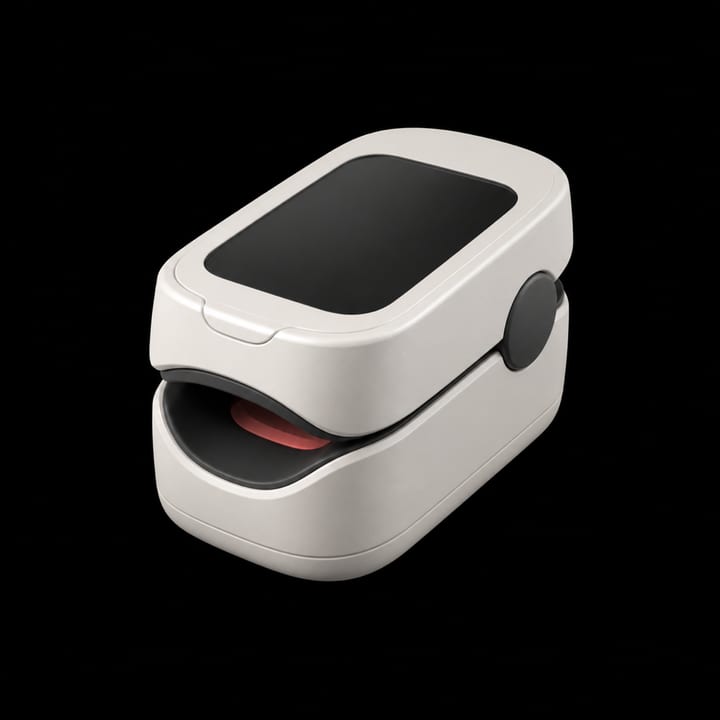
- Each morning, write down the night’s average and its lowest point, from the same device worn the same way.
- Compare with three ordinary nights. If the side nights come out higher, you’ve found something to bring to your doctor, and something to keep doing.
The card below dates the three nights for you and has a box for “Slept on my back”, so the pattern is easy to see.
Who should skip the test and see a doctor?
Anyone whose bed partner has seen them stop breathing in their sleep. Also anyone who snores loudly and feels sleepy in the day, even after a full night. Those are two of the signs doctors ask about first, along with high blood pressure, and a sleep study answers the question that sleeping on your side can’t (how to know).
4 sources
- Rosa CFA and others, Analysis of positional obstructive sleep apnea features in 12,000 patients at a sleep center, Sleep and Breathing, 2026europepmc.org
- Kolla BP and others, The impact of alcohol on breathing parameters during sleep: a systematic review and meta-analysis, Sleep Medicine Reviews, 2018europepmc.org
- Gries RE and Brooks LJ, Normal oxyhemoglobin saturation during sleep: how low does it go?, Chest, 1996europepmc.org
- Chung F, Abdullah HR and Liao P, STOP-Bang questionnaire: a practical approach to screen for obstructive sleep apnea, Chest, 2016europepmc.org