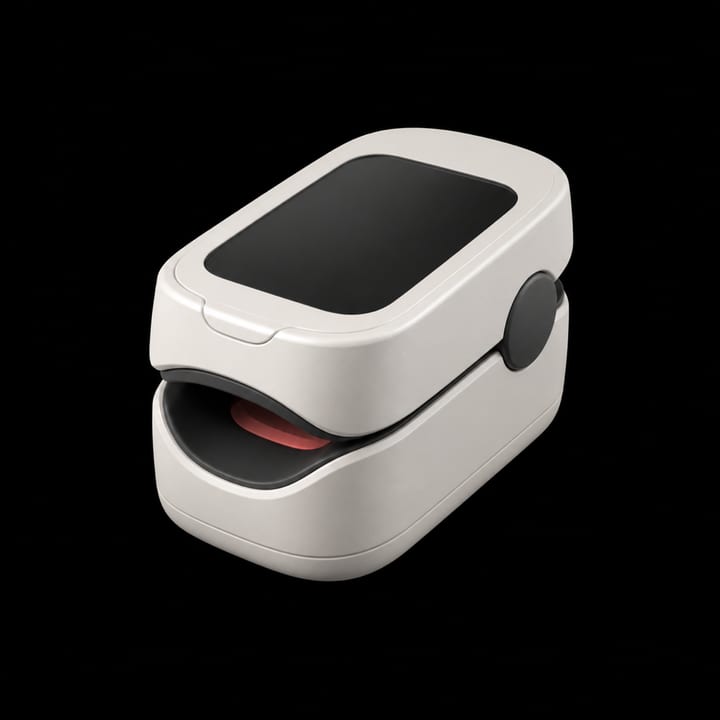

Anything under 95 means something's wrong
Short answerNot the way you think
On this page
Not the way you think. 95 to 100 is the normal range when you’re awake and resting at a low elevation. Asleep, most people run about a point lower, the lowest point of a healthy night averaged about 90, and anyone living up high sits lower all the time. Awake and resting, the line for calling your doctor is 92.
Call 911 if you have trouble breathing, chest pain or pressure that doesn't go away, new confusion, can't stay awake, or your lips, nail beds or skin look pale, gray or blue, whatever the number says.
What we’d do
First ask when the number was taken. Awake and resting, recheck a 93 or 94 with warm hands while sitting still, and call your doctor if it stays at 92 or lower. Asleep, compare it with your own usual nights on the same device. Up high, compare it with people who live there. In every case, how you feel decides more than the number.
If you remember three things
- 95 is where awake normal starts. Action starts at 92.
- Night numbers run lower. Apple says some people see values under 95 in sleep, and that’s expected.
- Elevation moves the line. In Denver, a typical watch night for a 40-year-old runs about 91.6 to 96.5.
Why it sounds right
Every chart says normal is 95 to 100, and a watch shows the number with no context. A 94 sits one step outside the box, so it looks like a fail. The chart doesn’t say it was made for people awake, sitting down, near sea level.
Is a shop closed for good if it’s shut at midnight?
The hours on a shop door tell you when it’s usually open. Finding it shut at midnight doesn’t mean it went out of business. You’d only worry if it stayed shut during its own opening hours, day after day.
95 to 100 is the opening hours for an awake, resting person at a low elevation. A night number, or a number in Denver, is the shop at midnight.
When is under 95 normal?
- Asleep. In 33,080 Apple Watch wearers, the average night was 95.4, against 96.2 by day. For a 40-year-old at sea level, the model of that study puts the typical night average at about 93.5 to 98.4, and about 1 in 5 people like that would usually average under 95, if the spread is normal. Apple’s own page says “some users might experience values below 95%” while sleeping.
- At the lowest point of the night. In 350 people whose sleep studies came back normal, the lowest point averaged 90.4, and most fell between about 84 and 97.
- Older. In that sleep lab study, people over 60 had a median through the night of 95.1.
- Up high. MedlinePlus notes numbers can be lower at higher elevation. In Denver, a 40-year-old’s typical watch night runs about 91.6 to 96.5, so about 4 in 5 would usually average under 95.
When is under 95 a problem?
Awake and resting, MedlinePlus says to contact your doctor at 92 or lower and to get medical care right away at 88 or lower. At 93 or 94, recheck sitting still for a few minutes, with warm hands and a finger without dark polish.
At night, the problem is a pattern. An overnight average under 90, low points that keep dropping under 90 night after night, or someone seeing you stop breathing are reasons to call your doctor. The three-night check sorts one low night from a pattern.
And the 911 signs beat any number. Trouble breathing, chest pain, new confusion or gray or blue lips means call 911 even at 97.
Can a 95 hide something lower?
Yes, and that’s the other half of this myth. Oximeters tend to show too high when oxygen is low, and more so on darker skin. In hospital patients whose finger oximeter showed 92 to 96, true oxygen was under 88 for 11.7% of Black patients’ measurements and 3.6% of White patients’. In 9 young adults in a lab, an Apple Watch Series 7 showed too high most of the time once true oxygen fell under 88.
The number 95 is less of a wall than people think, in both directions. A 94 is often fine, and a 95 with symptoms isn’t a reason to wait.
The best case for the myth
“MedlinePlus says normal is 95 to 100, so anything less is abnormal by definition.” That’s true for an awake, resting person, and MedlinePlus is the source of that line. The same page says numbers can be lower at higher elevations, and somewhat lower can be acceptable for people with lung disease. It sets the action line at 92. The watch study adds the night, and the sleep lab study adds the lowest point. Put together, under 95 is a reason to check when and where, and then to look at 92 and 88.
Is my blood oxygen normal? Take the quiz All the myths
7 sources
- MedlinePlus, Pulse Oximetry, US National Library of Medicine, updated September 12, 2024medlineplus.gov
- Apple Support, About Blood Oxygen on Apple Watch, checked 2026-11-14support.apple.com
- Shapiro I and others, Pulse oximetry values from 33,080 participants in the Apple Heart and Movement Study, npj Digital Medicine, 2023pmc.ncbi.nlm.nih.gov
- Gries RE and Brooks LJ, Normal oxyhemoglobin saturation during sleep: how low does it go?, Chest, 1996europepmc.org
- Sjoding MW and others, Racial bias in pulse oximetry measurement, New England Journal of Medicine, 2020pmc.ncbi.nlm.nih.gov
- CDC, Symptoms of COVID-19, emergency warning signscdc.gov
- Jiang Y and others, Performance of wearable pulse oximetry during controlled hypoxia induction: instrument validation study, JMIR Formative Research, 2026pmc.ncbi.nlm.nih.gov